
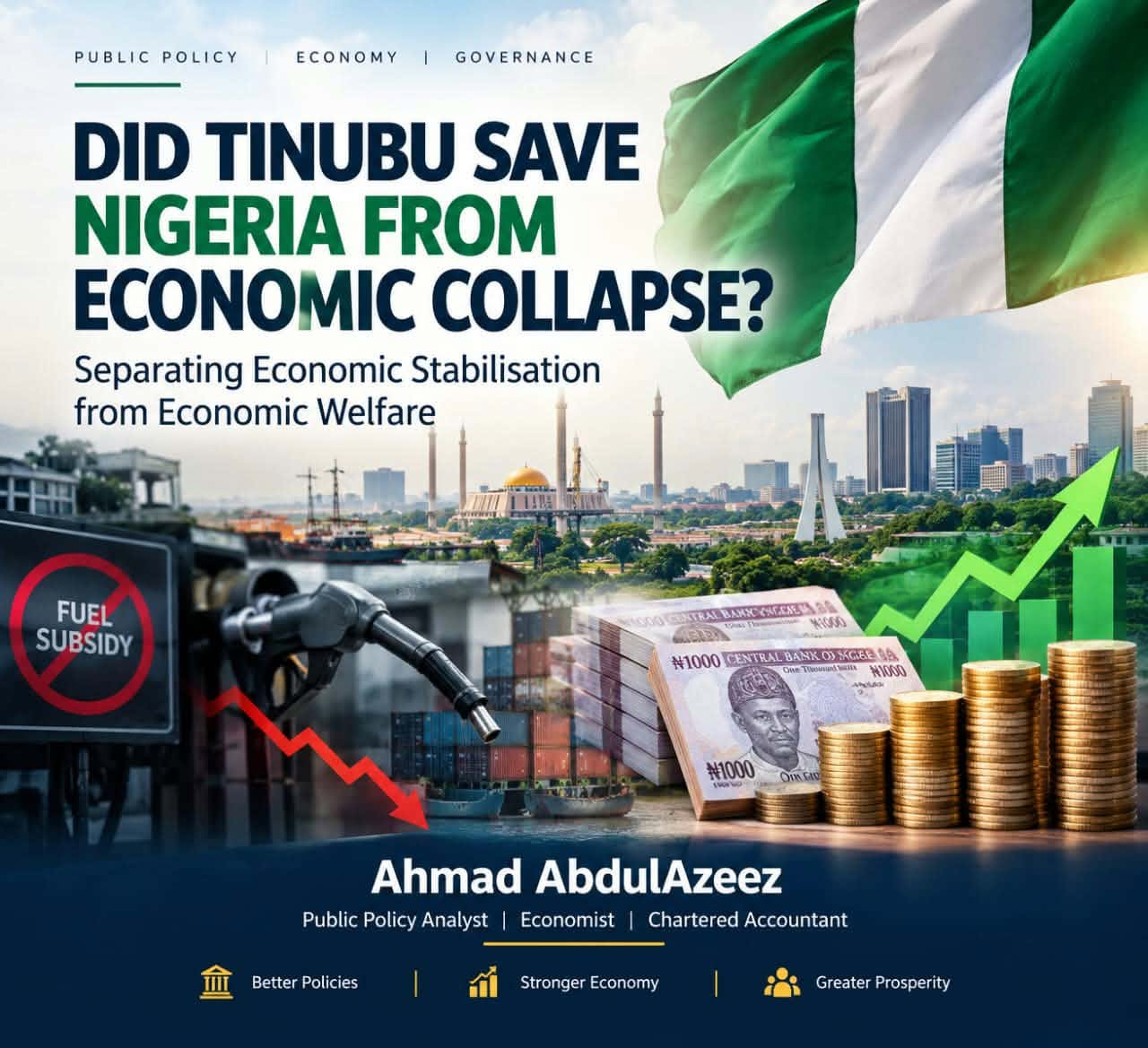
Share the post "DID TINUBU SAVE NIGERIA FROM ECONOMIC COLLAPSE?Separating Economic Stabilisation from Economic Welfare"
I have been following the debate around Vice President Kashim Shettima’s statement that President Bola Ahmed Tinubu saved Nigeria from economic collapse.
It is a statement that has generated different reactions, and I think it deserves a more honest conversation.
For me, this should not be about whether someone supports APC or belongs to the opposition. It should be about looking at where Nigeria was before this administration, what has happened since then and where the country is going.
One thing is difficult to dispute: Nigeria was already facing serious economic problems before President Tinubu came into office.
Government revenue was weak. Debt-service obligations were putting pressure on public finances. We had serious foreign-exchange challenges, high inflation and the increasing cost of maintaining the petrol subsidy.
These problems did not begin with Tinubu. They developed over several years and under different administrations.
At the same time, it is also important to acknowledge that the Tinubu administration took some very difficult decisions, particularly the removal of the petrol subsidy and changes in the foreign-exchange system.
People can disagree about how these policies were implemented and about their consequences. But there is no doubt that they were major decisions.
Some of the changes appear to have helped improve government finances and contributed to greater macroeconomic stability.
But this is where I believe we need to look beyond the headlines.
An economy can become more stable without the people necessarily becoming better off.
This distinction is very important.
Government revenue may improve while a family is still struggling to buy food.
The foreign-exchange market may become more orderly while a business owner is still dealing with high operating costs.
Inflation may slow down while Nigerians continue to pay prices that are far higher than what they were paying a few years ago.
Consider a simple example.
If something that used to cost ₦100 rises to ₦300 and later rises to ₦315, the rate at which the price is increasing has slowed. But nobody will tell the person buying that item that it has become cheap.
That is why I think both sides of this debate need to be heard.
The government can point to the reforms and improvements in some economic indicators.
Those who are critical of the government can also ask a legitimate question:
When will the benefits of these reforms become more visible in the lives of ordinary Nigerians?
That, for me, is the bigger question.
As a Public Policy Analyst, Economist and Chartered Accountant, I do not think we should judge an economy only by government revenue, GDP growth or other macroeconomic figures.
We should also look at what is happening to the people.
Are Nigerians finding better opportunities?
Are businesses able to survive and grow?
Are incomes improving?
Is poverty reducing?
Can families comfortably afford food, housing, transportation and healthcare?
Are public services getting better?
These are not political questions. They are development questions.
So, did Tinubu save Nigeria from economic collapse?
My honest view is that the administration inherited serious fiscal and structural challenges and has taken significant steps to address some of them. Those steps have contributed to economic stabilisation in important areas.
But I would be careful about saying that Nigeria has been completely rescued.
We are still on the journey.
The real test will be what these reforms produce over time.
If they lead to stronger businesses, more jobs, improved purchasing power, reduced poverty and better public services, then history may judge the difficult decisions more favourably.
But if the economy becomes more stable mainly in the statistics while households continue to struggle, then we will have to ask whether the stability is translating into real development.
For me, that is the point we should not lose sight of.
Nigeria does not only need economic stability. We need stability that eventually translates into prosperity for the people.
That, ultimately, is how I believe we should judge whether Nigeria has truly been saved.
Ahmad AbdulAzeez
Public Policy Analyst | Economist | Chartered Accountant
#Nigeria #PublicPolicy #NigeriaEconomy #EconomicReforms #EconomicDevelopment #Governance
Share the post "DID TINUBU SAVE NIGERIA FROM ECONOMIC COLLAPSE?Separating Economic Stabilisation from Economic Welfare"
Discover more from Big News
Subscribe to get the latest posts sent to your email.